


Week of August 24, 2026

Published every Monday: Get a detailed snapshot of what moved the markets last week—and what to watch this week.

Large-cap stock indices, led by the technology and communication services sectors, were marginally higher.

Small-cap stocks and the health care and energy sectors underperformed. Bond markets were modestly higher as yields on long-term Treasuries declined.

Weekly Quick Hits

Beyond the Headlines

Federal Reserve (Fed) chair calms markets, but inflation remains the focus.

Report Releases

Manufacturing strength and consumer concerns about the future were key takeaways.

Financial Market Data

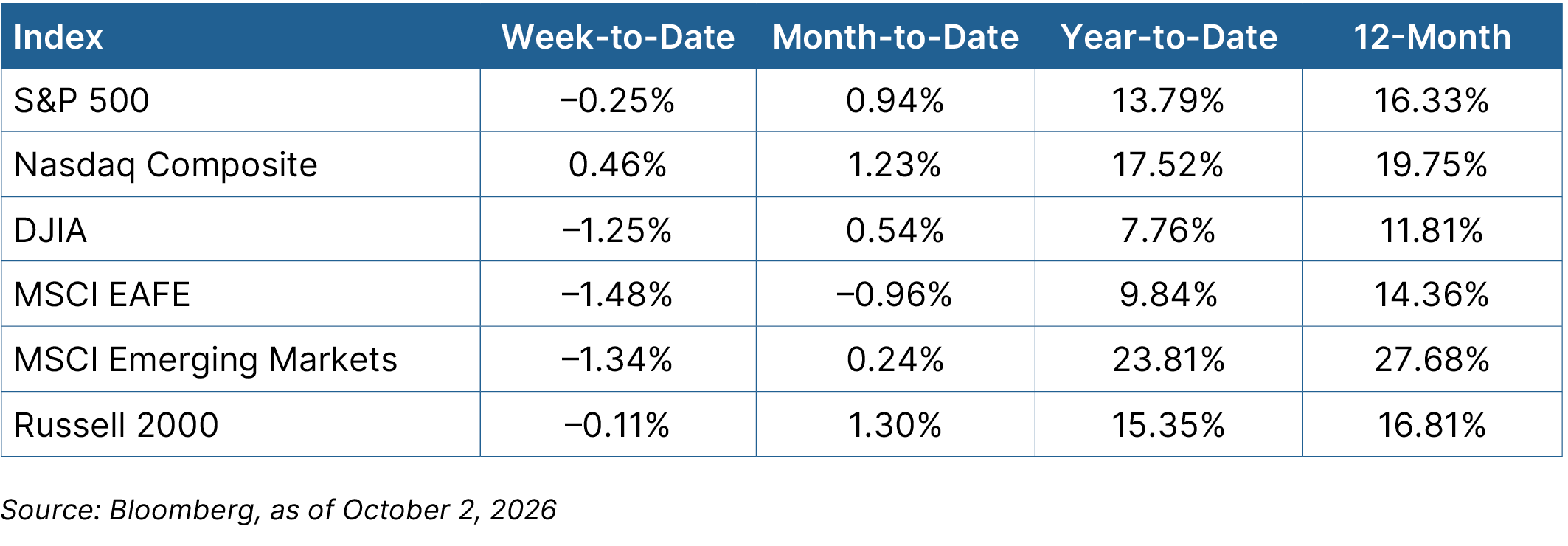
Large-cap stocks advanced, led by growth-oriented sectors, while small-cap stocks underperformed.

Looking Ahead

Economists and investors will closely watch Friday’s employment report.

BEYOND THE HEADLINES:

Fed Chair Calms Markets, but Inflation Remains the Focus

Fed Chair Kevin Warsh made his highly anticipated first speech at the Jackson Hole Economic Symposium on Friday morning. Long-term Treasury yields have been under pressure recently, with yields on the 30-year approaching levels last seen in 2007. Warsh clearly positioned inflation as the central bank’s primary concern. He also expressed confidence in a growing economy, a resilient labor market, and the long-term economic benefits of artificial intelligence (AI).

Fighting Inflation Comes First
Warsh again made it clear that the Fed is focused on returning inflation to its 2 percent target, a level that inflation has remained above for the past five years. He mentioned that although progress has been made since inflation spiked in 2022, there has been little additional improvement over the past couple of years. He added that despite improvements in the inflationary trend over the past few months, they haven’t been sufficient to give the Fed confidence that the trend is sustainable.

Warsh’s comments that short-term rates are the appropriate tool for fighting inflation led markets to infer that the Fed will raise rates before the end of the year. Market expectations have once again shifted toward better than even odds that the Fed will raise rates at its next meeting on September 16.

Economic Backdrop Remains Solid
Warsh noted that the economy is doing well and may be strengthening despite the various headwinds it has faced. Resilient consumer spending and rising business investment should support continued economic growth. Warsh was equally upbeat about the labor market, calling it stable and consistent with the Fed’s goal of maximum employment.

Although the chair presented a balanced view of the issues surrounding the rollout of AI (e.g., who profits from it and its effects on jobs), he seemed optimistic about the impact AI could have on economic growth. He cited AI’s potential to increase productivity, which could lead to noninflationary economic growth.

Earnings to the Rescue
Just as markets begin to worry about headlines, corporate America has proved adept at navigating higher inflation and interest rates by delivering strong earnings growth. Last week was no exception, as market bellwether Nvidia reported earnings that helped fuel a strong rally.

Fundamentals drive markets, and third- and fourth-quarter estimates as well as full-year estimates for the S&P 500 have continued to move higher. Despite potential near-term volatility, strong earnings growth should provide a supportive backdrop for investors moving forward.


“The Fed is likely to remain focused on price stability and hold rates steady. This would give it time to assess additional data over the next several months and determine whether the trend of moderating inflation continues.

Report Releases: August 24–28, 2026

Conference Board Consumer Confidence Index:
August (Tuesday)

Consumer confidence fell because of a sharp drop in expectations for future economic conditions.

  • Expected/prior month consumer confidence: 90.2/90.2
  • Actual consumer confidence: 89.4

Preliminary Durable Goods Orders:
July (Wednesday)

Headline and core durable goods orders showed solid growth in July, signaling healthy levels of business investment.

  • Expected/prior durable goods orders monthly change: +0.5%/+0.5%
  • Actual durable goods orders monthly change: +1.1%
  • Expected/prior core durable goods orders monthly change: +0.6%/+1.1%
  • Actual core durable goods orders monthly change: +0.4%

The Takeaway


  • Manufacturing showed strength, with durable goods orders posting solid month-over-month growth.
  • Consumer confidence unexpectedly fell amid continued concerns about the future of the economy.

Financial Market Data

Equity

Stocks were mixed, with most major indices posting modest gains. The Nasdaq Composite fared best, rising 0.85 percent. The S&P 500 and Dow Jones Industrial Average each rose roughly 0.5 percent. The Russell 2000 declined about 1.5 percent, and the equal-weighted S&P 500 fell slightly for the second week in a row. The technology, communication services, and financial sectors each rose more than 1 percent. The declining sectors were health care, energy, industrials, and real estate. International developed markets and emerging markets were largely unchanged.

Fixed Income

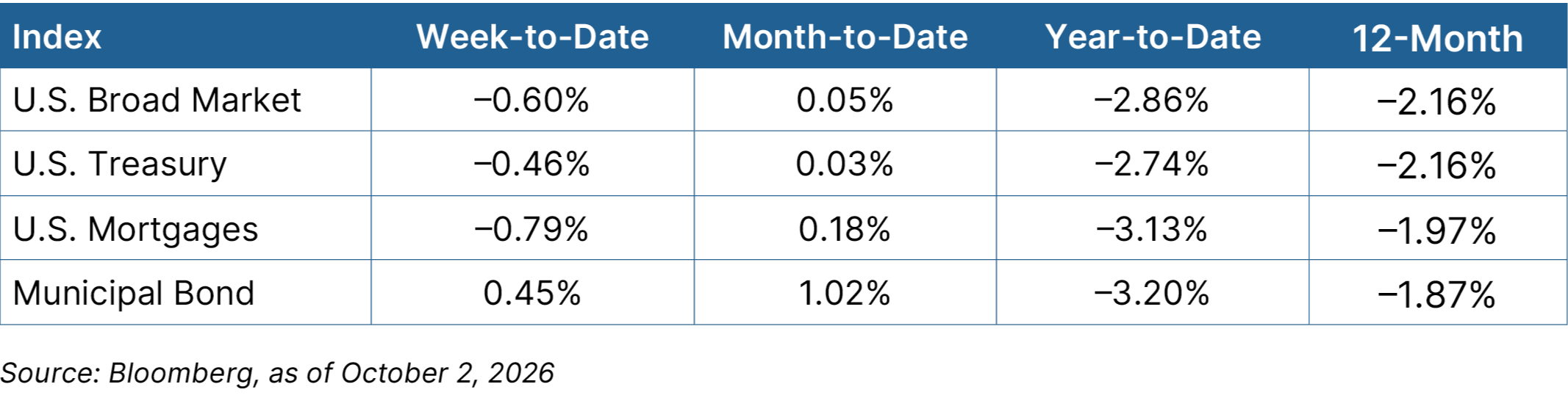
Bonds were modestly higher, with long-term Treasury yields declining. Inflation remained in focus after Warsh’s speech at Jackson Hole, leading to a sell-off in short-term Treasuries and a flattening of the yield curve. Core bonds, Treasuries, and mortgages were up slightly, while the municipal market sold off marginally.

The Takeaway


  • Large-cap indices rose, but other areas showed weakness. Growth sectors such as technology and communication services rose; the health care and energy sectors lagged.
  • Fixed income markets were marginally higher, with long-term Treasury yields moving lower and short-term yields increasing, as inflation remained in focus.
Looking Ahead Image

Looking Ahead

The highlight this week is expected to be an update on the labor market. After a surprising drop in July, economists expect a modest improvement in hiring, which would be a welcome sign for the Fed.

  • The week kicks off on Tuesday with the Institute for Supply Management (ISM) Manufacturing index for August. The index is expected to decline modestly but remain in expansionary territory.
  • On Thursday, we’ll see the ISM Services index for August. Consensus expectations are that services confidence will rise slightly, marking two consecutive months of improvement.
  • Lastly, on Friday, we’ll see the August employment report. It’s expected to show a modest improvement in hiring, with roughly 60,000 new jobs added after July’s decline.

Disclosure: This material is intended for informational/educational purposes only and should not be construed as investment advice, a solicitation, or a recommendation to buy or sell any security or investment product. Diversification does not assure a profit or protect against loss in declining markets, and diversification cannot guarantee that any objective or goal will be achieved. Please contact your financial professional for more information specific to your situation.

Bonds are subject to availability and market conditions; some have call features that may affect income. Bond prices and yields are inversely related: when the price goes up, the yield goes down, and vice versa. Market risk is a consideration if sold or redeemed prior to maturity.

Certain sections of this commentary contain forward-looking statements that are based on our reasonable expectations, estimates, projections, and assumptions. Forward-looking statements are not guarantees of future performance and involve certain risks and uncertainties, which are difficult to predict. All indices are unmanaged and are not available for direct investment by the public. Past performance is not indicative of future results. The S&P 500 is based on the average performance of the 500 industrial stocks monitored by Standard & Poor’s. The Nasdaq Composite Index measures the performance of all issues listed in the Nasdaq Stock Market, except for rights, warrants, units, and convertible debentures. The Dow Jones Industrial Average is computed by summing the prices of the stocks of 30 large companies and then dividing that total by an adjusted value, one which has been adjusted over the years to account for the effects of stock splits on the prices of the 30 companies. Dividends are reinvested to reflect the actual performance of the underlying securities. The MSCI EAFE Index is a float-adjusted market capitalization index designed to measure developed market equity performance, excluding the U.S. and Canada. The MSCI Emerging Markets Index is a market capitalization-weighted index composed of companies representative of the market structure of 26 emerging market countries in Europe, Latin America, and the Pacific Basin. The Russell 2000® Index measures the performance of the 2,000 smallest companies in the Russell 3000® Index. The Bloomberg US Aggregate Bond Index is an unmanaged market value-weighted performance benchmark for investment-grade fixed-rate debt issues, including government, corporate, asset-backed, and mortgage-backed securities with maturities of at least one year. The U.S. Treasury Index is based on the auctions of U.S. Treasury bills, or on the U.S. Treasury’s daily yield curve. The Bloomberg US Mortgage Backed Securities (MBS) Index is an unmanaged market value-weighted index of 15- and 30-year fixed-rate securities backed by mortgage pools of the Government National Mortgage Association (GNMA), Federal National Mortgage Association (Fannie Mae), and the Federal Home Loan Mortgage Corporation (FHLMC), and balloon mortgages with fixed-rate coupons. The Bloomberg US Municipal Index includes investment-grade, tax-exempt, and fixed-rate bonds with long-term maturities (greater than 2 years) selected from issues larger than $50 million. One basis point is equal to 1/100th of 1 percent, or 0.01 percent.

Authored by the Investment Research team at Commonwealth Financial Network®.

© 2026 Commonwealth Financial Network®

Let’s Talk About Your Financial Future

Whether you’re navigating a volatile market or preparing for the future, we’re here to help.

Schedule a Consultation